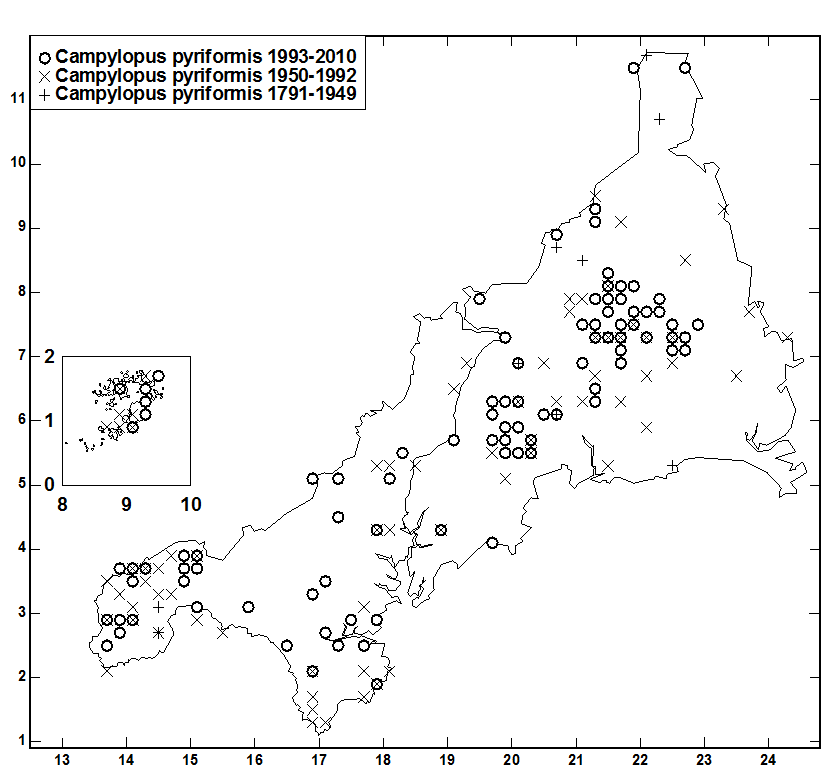
*1: Trevelloe Carn,
1864, WC (PNZ) (Paton 1969a:
718).
*2: De Lank, St
Breward, 1891, RVT (B) (Paton 1969a:
718).
Var. azoricus was not
usually distinguished until the study by Corley (1976: 211),
which recorded it from vc2; it is maintained as a var. by
Blockeel & Long (1998: 80) and Smith (2004: 224) but not
by Hill et al.
(2008). It is not recognised here because Frahm (1999)
regarded it as merely a modification from wet
habitats.
Habitat notes from C&S are as follows. Forms
patches on acidic soil (often where moist to wet, and humic or
peaty), tussocks of Molinia caerulea,
bared peat and on decaying wood (mainly rotting stumps,
several times recorded on those of pine and Sitka Spruce, but
also hardwoods; once on decaying twig of Grey Willow). Most
commonly grows in open but also in sites partly shaded by Grey
Willow or in open woodland. Occurs on sea-cliffs, in flushes,
on coastal and inland heaths, in mires, areas with Juncus effusus, in
damp or wet areas among china clay spoil (including floor of a
working quarry and marsh forming on floor of old quarry), on
old mining ground, among steep rocks in old slate quarry, in
open and shaded areas in Grey Willow carrs and in woodland
edges and clearings (including conifer plantations). Sometimes
becomes plentiful for several years after heathland is burnt.
Associates recorded include Atrichum undulatum, Calypogeia
muelleriana, Campylopus
introflexus, Cephalozia
bicuspidata, Gymnocolea inflata, Solenostoma
gracillimum, Kurzia
sylvatica, Lophozia
incisa Lophozia
ventricosa, Mylia
anomala, Odontoschisma sphagni,
Polytrichum
commune, Riccardia
latifrons, Riccardia
multifida.
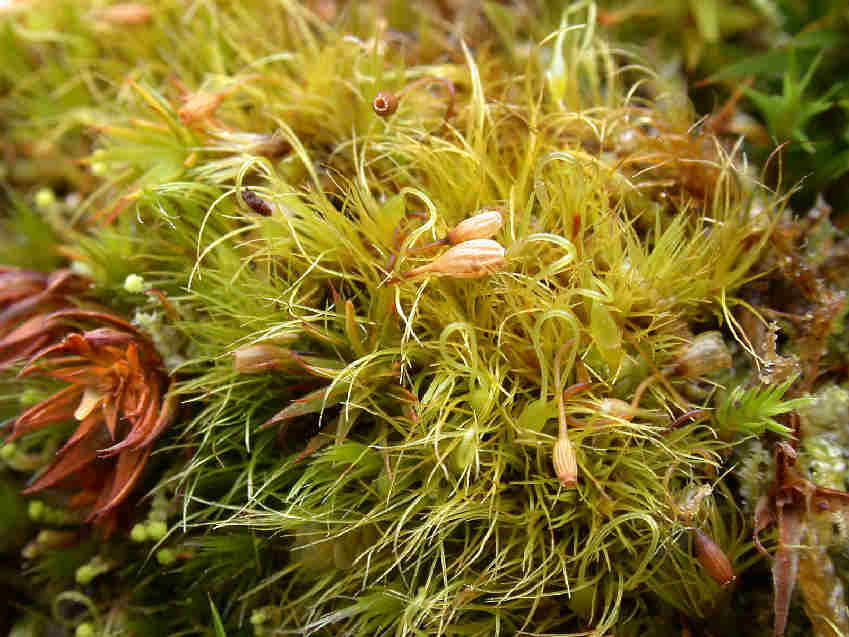
Commonly reproduces vegetatively by caducous leaves
(these seen in plenty on fertile as well as sterile stems).
Frequently c.fr., capsules immature 1-5, 7, 9-11; dehiscing
3-5, 7; dehisced 2-5, 7, 10.